Wissam Al Mana Net Worth – Unveiling the Billionaire Retail Entrepreneur
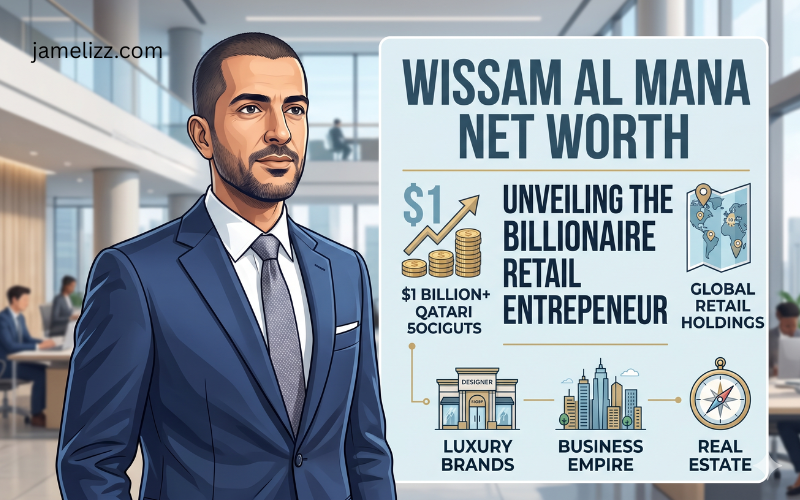
Most people first heard the name Wissam Al Mana when he married Janet Jackson. That is understandable. Celebrity news travels fast. But if you look past that headline, you find something far more interesting: a Qatari businessman who quietly built one of the most powerful retail empires in the Middle East, with a net worth sitting at an estimated $1 billion and a conglomerate generating over $2 billion in annual turnover.
This is not a story about inherited luck. It is a story about a man who took his father’s trading business, reorganized it from scratch alongside his brothers, locked down exclusive distribution rights for some of the world’s most prestigious luxury brands, and expanded aggressively across eight countries.
In this article, you will get the full picture: where the money actually comes from, how the Al Mana Group is structured, what competitors consistently miss about his business strategy, and what he has been doing in 2024 and 2025.
Quick Facts: Wissam Al Mana at a Glance
| Full Name | Wissam Saleh Al Mana |
| Date of Birth | January 1, 1975 |
| Nationality | Qatari |
| Estimated Net Worth | $1 Billion (2025) |
| Role | Co-Managing Director and Board Member, Al Mana Group |
| Brothers | Hisham Saleh Al Mana, Kamal Saleh Al Mana |
| Son | Eissa Al Mana (born January 3, 2017) |
| Group Founded | 1951 (by father Saleh Al Hamad Al Mana); restructured 2003 |
| Group Annual Turnover | $2 Billion+ (2023 estimate) |
| Operations | 55+ companies, 8 countries, 5,500+ employees, 300+ retail outlets |
What Is Wissam Al Mana’s Net Worth in 2025?
Wissam Al Mana’s net worth is estimated at $1 billion as of 2025. This figure reflects his personal equity stake in the Al Mana Group, accumulated through decades of luxury retail partnerships, franchise operations, automotive dealerships, and real estate holdings across the Gulf Cooperation Council region and beyond.
Here is something most articles skip entirely: the $1 billion personal net worth figure and the group’s $2 billion+ annual revenue are not the same thing. One is what Wissam is worth. The other is how much money flows through the business each year.
Think of it this way. The group generates enormous revenue, but that revenue is shared across Wissam, his two brothers, operational costs, reinvestments, and staff across eight countries. Wissam’s personal stake represents his share of the business’s total equity value, not its annual sales.
What makes the $1 billion figure notable is this: it is almost entirely derived from non-oil business. No sovereign wealth fund. No petroleum contracts. Pure retail, franchise, and real estate strategy. In a region where most billion-dollar fortunes trace back to oil, that distinction matters.
The Al Mana Family Dynasty: Where It All Started
Who Was Saleh Al Hamad Al Mana?
The Al Mana story begins not with Wissam, but with his father. Saleh Al Hamad Al Mana was a Qatari merchant who started trading in the early 1950s when Qatar was still a largely undeveloped emirate. He had the foresight to see what the region could become. He diversified early, moving from basic importing and trading into construction, automotive distribution, and real estate as Qatar began its rapid modernization.
Wissam has spoken about his father in several interviews, consistently describing him as the defining influence in his life, both as a businessman and as a person. He often points to his father’s work ethic, humility, and discipline as the values that shaped everything he has built since.
How the Three Brothers Rebuilt the Group in 2003
This is the part most articles miss completely. The Al Mana Group as it exists today is not simply the company Saleh Al Hamad Al Mana left behind. In 2003, Wissam and his two brothers, Hisham and Kamal, made a deliberate decision to consolidate their separate business interests into a single unified group.
That reorganization was a strategic pivot, not a formality. Three separate businesses, each with their own operations, were brought under one structure. The brothers divided responsibilities across the group’s major divisions. Wissam took charge specifically of the retail and luxury brand operations, which became the most visible and internationally recognized part of the empire.
This is why understanding the 2003 restructuring matters: it is the moment the modern Al Mana Group was born, and it is the foundation on which the $2 billion turnover figure was eventually built.
Wissam’s Role vs His Brothers
Wissam serves as Co-Managing Director and Board Member of the Al Mana Group, with a specific focus on retail, luxury goods, fashion, and international brand partnerships. His brother Hisham and brother Kamal oversee other divisions within the conglomerate. The three operate as a leadership unit rather than a hierarchy, which has been a deliberate design choice. It is a family business run with the discipline of a corporate structure.
How Wissam Al Mana Built His Personal Fortune
The wealth did not arrive in one go. It was assembled pillar by pillar over two decades. Here is exactly how each piece contributes.
The Luxury Retail Engine
This is the crown jewel. Wissam secured exclusive distribution and retail rights for some of the most valuable luxury brands in the world, operating them across the Gulf markets. When a customer walks into a Hermès store in Doha or an Armani boutique in Kuwait City, they are shopping in a space the Al Mana Group built, staffed, and operates.
The business model here is highly profitable. Exclusive regional licensing agreements with top-tier luxury houses mean limited competition and strong margin control. Hermès, Giorgio Armani, Balenciaga, Harvey Nichols, Saks Fifth Avenue stores in Dubai and Doha, Roberto Cavalli, Stella McCartney, Agent Provocateur. These are not minor partnerships. These are flagship agreements worth hundreds of millions over their lifetimes.
Wissam personally directs this division. His profile on the Business of Fashion 500 describes him as widely regarded as a bridge between Western brand identities and Middle Eastern cultural nuances. That positioning is not marketing language. It is the actual business advantage he brings to the table when luxury houses decide which regional partner to trust with their brand equity.
The Franchise Model
Luxury retail is high margin but relatively low volume. The franchise model adds volume. The Al Mana Group operates all McDonald’s locations in Qatar. That alone is a significant recurring revenue stream in a country where fast food demand continues to grow alongside an expanding expatriate population.
Beyond McDonald’s, Wissam signed an exclusive licensing deal with HMV for the Middle East in 2015 to develop retail stores and digital services. In 2016, the group partnered with the NBA to open the first branded merchandise stores in the Middle East, starting in Qatar and expanding into Saudi Arabia, the UAE, and Kuwait. These franchise agreements layer predictable income on top of the luxury retail revenue.
Automotive Power
The Al Mana Group is the sole agent for Nissan, Renault, and Infiniti in Qatar. Being the exclusive dealer for three major automotive brands in a country where car ownership rates are among the highest in the world is a serious business. New car sales, servicing, parts, and financing all run through the group. This is the kind of agreement that generates consistent, recession-resistant revenue regardless of fashion cycles or consumer trends.
Real Estate Holdings in Qatar and the GCC
Real estate is the quiet wealth-builder in any billionaire’s portfolio, and the Al Mana Group is no exception. The group holds commercial and residential properties in Qatar’s most exclusive locations, as well as broader GCC property investments. As Qatar’s economy continues to grow and urbanize around the post-2022 World Cup infrastructure, these holdings appreciate steadily.
The $60 Million Egypt Investment (2024): What It Signals
2024 Update: Under Wissam’s leadership, the Al Mana Group committed a landmark $60 million investment into Egypt’s automotive sector, with a specific aim to establish local car assembly operations. This is not a small side bet. It signals that the group is actively moving beyond the GCC’s established markets and into North Africa’s much larger consumer base. Egypt’s automotive market is one of the fastest growing in Africa and the Middle East. Getting in early with local assembly capacity positions the group ahead of import restrictions and cost curves that purely import-dependent dealers will face in coming years.
Full Brand Portfolio Breakdown
No competitor article gives you this in one clean place. Here is the full landscape of what the Al Mana Group operates and distributes across the region.
| Category | Brands / Partners | Key Markets |
|---|---|---|
| Luxury Fashion | Hermès, Giorgio Armani, Emporio Armani, A/X Armani Exchange, Balenciaga, Roberto Cavalli, Stella McCartney, Sonia Rykiel, Agent Provocateur, Dior | Qatar, UAE, Kuwait, Bahrain, Oman, KSA |
| Department Stores | Harvey Nichols, Saks Fifth Avenue (stakes in Dubai, Doha, Bahrain, Kuwait) | Qatar, UAE, Kuwait, Bahrain |
| Automotive | Nissan (sole agent), Renault (sole agent), Infiniti (sole agent) | Qatar; Egypt (assembly, 2024) |
| Food and Beverage | McDonald’s Qatar (full franchise), Illy Coffee | Qatar |
| Fashion and Accessories | Calvin Klein, Adolfo Dominguez, Zara (GCC), Swatch Group | GCC wide |
| Entertainment and Media | HMV Middle East (exclusive licence, 2015), NBA merchandise stores (2016 partnership) | Qatar, UAE, KSA, Kuwait |
| Real Estate | Commercial and residential properties across Qatar’s premium locations; GCC investments | Qatar, GCC |
| Art and Investment | Lazinc Gallery (co-founder, London), iZest Marketing (angel investment, Ireland, 2018) | UK, Ireland |
Early Life, Education, and the West London Years
Wissam Al Mana was born on January 1, 1975, in Doha, Qatar. He grew up in West London, where the family relocated during his childhood years. That detail is more important than it sounds.
Growing up in London meant exposure to a different retail culture. The high street, the department store model, the luxury boutique ecosystem on Bond Street and Sloane Street. He absorbed all of it at a formative age, in a city where global fashion brands set their standards and compete at their highest level.
Note on Education Sources: Various websites claim different universities, ranging from the University of Westminster to George Washington University to the London School of Economics. The most credible and primary source, his own official website and his Business of Fashion 500 profile, confirms he was educated in both the United Kingdom and the United States. The specific institution is not verified with certainty. We report what is confirmed rather than repeat inaccurate claims for the sake of sounding detailed.
What is confirmed is that his educational path through the UK and US gave him fluency in both Western business culture and Middle Eastern market dynamics. The Business of Fashion describes him as a bridge between the two. That is exactly what he became.
He joined the family business young. One source notes he started working as a salesperson in retail at just 14. Whether or not that specific detail is precisely accurate, the broader truth holds: Wissam came up through the business, not alongside it. He did not walk in after business school and assume a title. He learned the operations from the ground level, which shaped how he manages the group today.
Wissam Al Mana and Janet Jackson: What the Headlines Miss
The Marriage, the Privacy, and Eissa
Wissam and Janet Jackson first met in 2010 at a hotel opening in Dubai. They married privately in 2012 and kept the marriage confidential until publicly acknowledging it in 2013. On January 3, 2017, their son Eissa Al Mana was born. Wissam has written personally and publicly about his son, expressing deep love and a clear commitment to fatherhood.
The Separation and the Reported Settlement
They separated in April 2017, just months after Eissa was born. The exact reasons were never officially stated. Speculation has centered on cultural differences and the demands of two very different public lives. Some sources estimate the divorce settlement at around $200 million, though neither party has confirmed any figure.
Why This Chapter Does Not Define His Legacy
The marriage brought Wissam global media attention he had never sought. He was a private businessman who happened to become famous because of who he was with. The attention is understandable. But it is worth being clear: his business accomplishments predate Janet Jackson by a decade, and they have continued to grow since the separation. The Al Mana Group’s $2 billion+ turnover and the $60 million Egypt expansion of 2024 have nothing to do with celebrity headlines. They are the product of long-term strategic thinking by a man who was building something serious long before anyone outside the GCC knew his name.
Beyond Business: Philanthropy and Art
UNICEF, Women’s Voices Now, and the Hoping Foundation
Wissam’s charitable work is genuinely substantive, and it is vastly underreported. He supports UNICEF, Women’s Voices Now (a media organization amplifying women’s stories from Muslim-majority countries), and the Hoping Foundation (which works with Palestinian refugee children). His philanthropic focus areas: women’s rights, children’s welfare, education access, healthcare, and environmental sustainability.
On his personal website, he writes directly to his son about the act of giving, describing it as an act of humanity, compassion, and generosity. He has been noted as a supporter of children’s and women’s charities across the Middle East who works towards improving educational access and advancing rights for girls globally.
Lazinc: The London Art Gallery Nobody Talks About
Wissam co-founded Lazinc, a contemporary art gallery based in London. Previously operating under the name Lazarides (a gallery known for launching urban artists including Banksy’s early commercial work), the gallery rebranded as Lazinc following Wissam’s co-founding investment in 2016. This is a side of his portfolio that almost no competitor article mentions. It signals an investment interest in cultural capital and contemporary art that goes well beyond the standard billionaire checklist of real estate and equities.
Wissam Al Mana’s Net Worth vs the Al Mana Group’s Scale
People often confuse personal net worth with business revenue. Let us put both numbers side by side so the picture is clear.
| Metric | Figure | What It Means |
|---|---|---|
| Wissam’s Personal Net Worth | $1 Billion | His equity stake across group assets, real estate, investments |
| Al Mana Group Annual Turnover | $2 Billion+ | Total revenue flowing through the group’s 55+ companies |
| Number of Companies | 55+ | Across retail, automotive, food, real estate, media, tech |
| Countries of Operation | 8 | Qatar, UAE, Kuwait, Oman, Bahrain, KSA, plus expanding |
| Employees | 5,500+ | Across all group operations globally |
| Retail Outlets | 300+ | Spanning luxury, fashion, food, automotive showrooms |
What Makes Wissam Al Mana Different From Other Middle East Billionaires?
This is a question worth sitting with for a moment. The Gulf region has no shortage of ultra-wealthy families. But most of that wealth traces back to oil, gas, or sovereign fund management. Wissam’s story is structurally different.
- No oil revenue. His wealth comes from retail, franchises, automotive dealerships, and real estate. Every dollar earned was generated through commerce, not extraction.
- Western brand expertise in a local market. Very few Middle Eastern businessmen have the cultural fluency to manage a Hermès flagship relationship and a McDonald’s franchise network simultaneously. He does.
- Family-run with corporate discipline. The Al Mana Group operates with the governance structure of a large corporation while retaining the long-term thinking of a family business. That combination is rare and hard to replicate.
- Geographic diversification within the GCC. Unlike many Qatar-focused businesses, the Al Mana Group operates meaningfully across six GCC countries, with recent expansion into Egypt signaling a push beyond the Gulf entirely.
The 2025 Forbes Recognition
In 2025, the Al Mana Group was named to the Forbes Middle East list of the Top 100 Arab Family Businesses. This recognition matters for two reasons.
First, it confirms what anyone paying attention already knew: this is not a small family operation operating quietly in Doha. This is one of the most significant family-owned conglomerates in the Arab world, measured by scale, longevity, and operational diversity. Second, it positions the Al Mana brand at a regional level that increases its leverage in future brand partnership negotiations, expansion discussions, and investment conversations.
Frequently Asked Questions
The Bottom Line on Wissam Al Mana’s Net Worth
Wissam Al Mana is not a billionaire because of celebrity. He is a billionaire because of two decades of disciplined, strategic business building in one of the world’s most competitive retail landscapes.
His $1 billion personal net worth is backed by a group generating $2 billion+ in annual revenue, exclusive luxury partnerships that took years to secure, a franchise portfolio spanning fast food to basketball merchandise, and an expanding automotive footprint that now reaches into Egypt.
The name became famous because of a marriage. The empire was built long before that, and it continues to grow long after.

Leave a Comment